where
num : pattern of a numeric token
d
+ : one or more digits
[±] : optional sign
E : exponent mark
ANSYS output files differ in encoding and line format depending on version and settings, so reading them reliably comes first.
The program tries several encodings in turn, splits each line on whitespace and keeps only the numeric tokens.
Values in exponent notation or with negative signs are not missed this way.
where
T : total reaction (sum of all supports)
VALUElast
: last VALUE row in the file
F
X
, F
Y
, F
Z
: reaction forces
M
X
, M
Y
, M
Z
: reaction moments
n
num
: number of numeric tokens in a row
The TOTAL value in the reaction output is the sum of all support reactions and should equal the seismic load applied to the whole model.
The program reads the last TOTAL block in the file and falls back to the VALUE row when the format differs.
This value serves as a check that every node result was read.
where
N : node number (positive integer)
ℤ
+ : set of positive integers
n
num
: number of numeric tokens in a row
F, M : reaction forces and moments
k : row index
The anchor check needs FX, FY and FZ at each support node.
The program keeps only the rows that start with a node number and preserves the output order so the values are easy to compare with the original table.
These values become the input for the bolt tension and shear check.
When the results for each direction are in separate files, mistakes creep in while moving them into a calculation.
The program creates a sheet for each direction and writes the node values and totals in the same format.
With no manual copying, transfer errors are reduced as well.
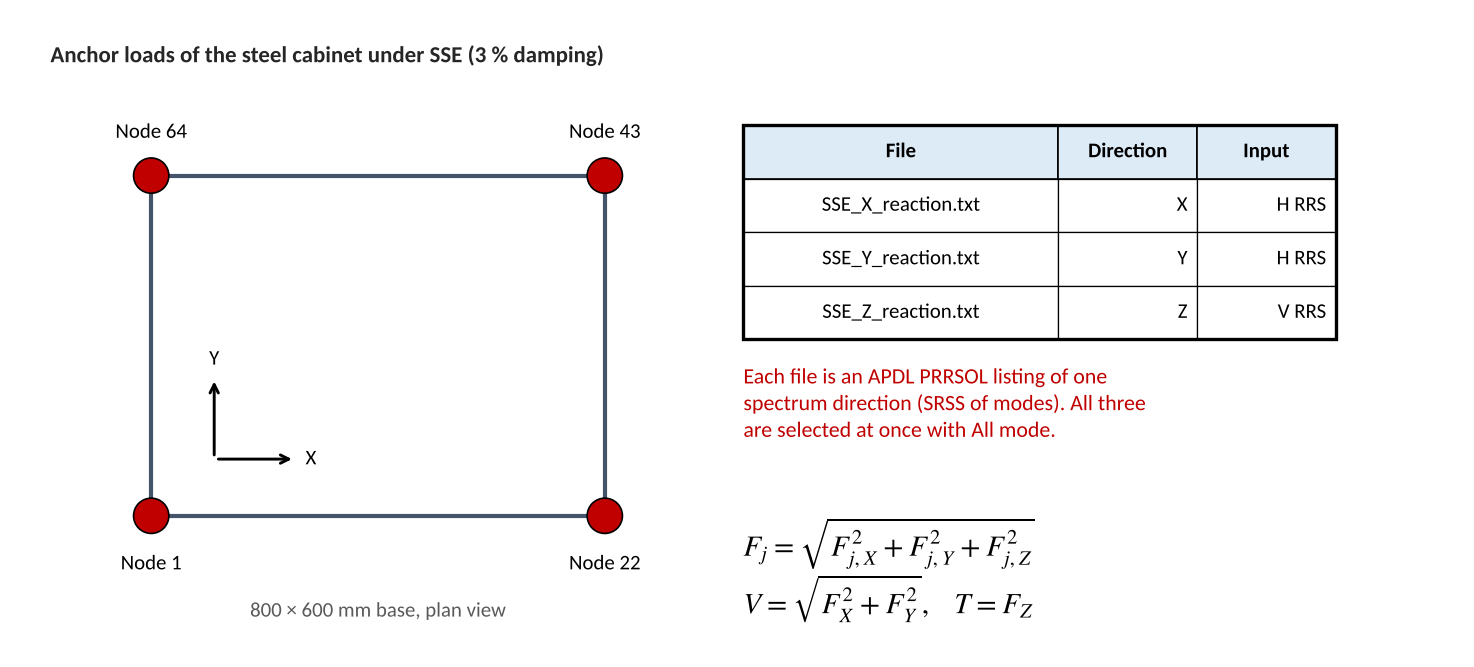
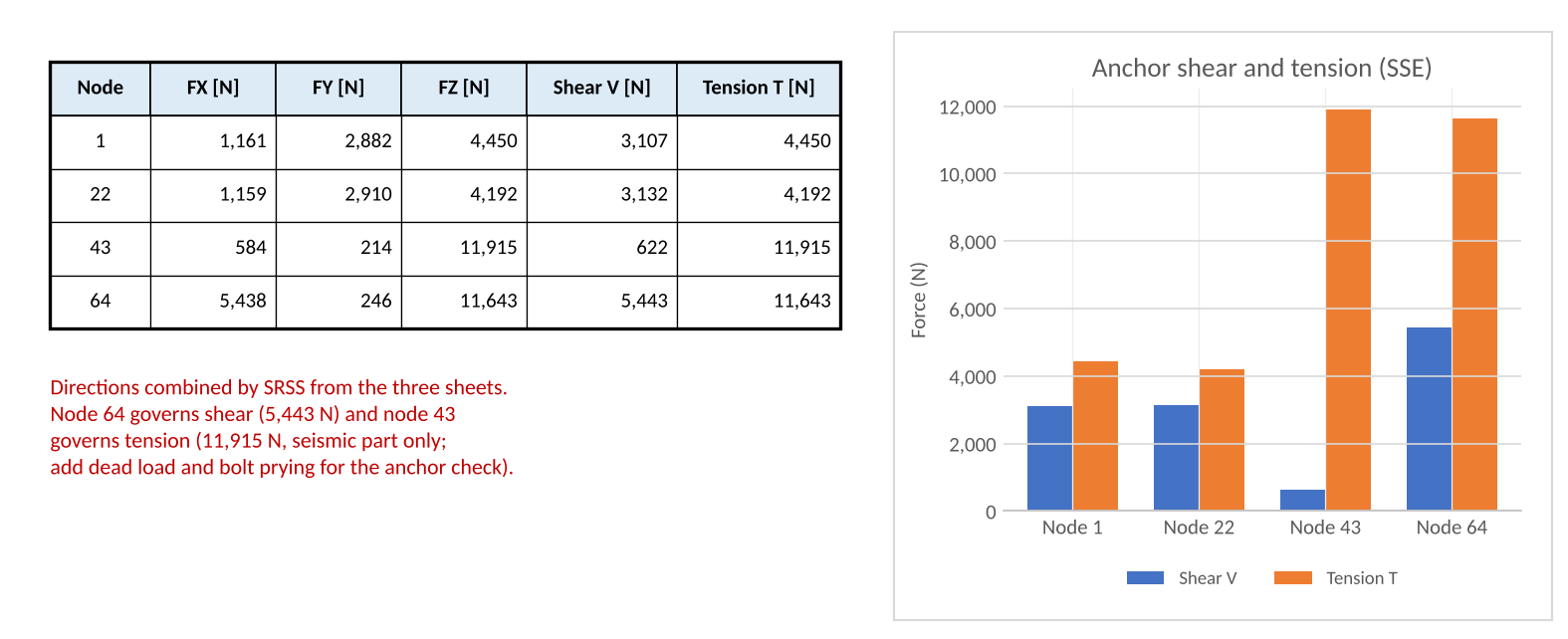
This example reads the three SSE reaction listings (X, Y and Z spectra, 3 % damping) of the synthetic 412 kg steel cabinet with All mode, so each of the four anchor nodes gets FX, FY and FZ in three sheets. The directions are then combined by SRSS per node: node 64 governs the shear with 5,443 N and node 43 governs the tension with 11,915 N, the seismic part to which dead load and bolt prying are added for the anchor check.
 Return to the Extract Nodal Load Page